
Protect your pump from mechanical damage with a digital load monitor.
The digital load monitor is an intelligent control unit that ensures pumps and motors run at optimal levels, protecting the pump from damage caused by a change in operating conditions such as dry running, blocked discharge lines, closed valves or empty supply tanks.
It measures true power consumption of three-phase AC motors, displayed as a percentage of a selected power range.
If operating conditions change from the normal operating point on a pump curve, the power monitor automatically trips the motor before mechanical damage and failure to the pump occurs.
Control Functions:
Two independent programmable trip functions activate a single alarm relay which can be used to control the motor being monitored:
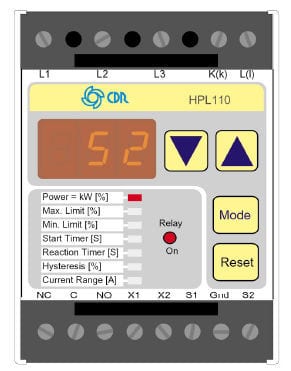
As pump flows change due to demand, tank levels, blocked filters or dry running, power requirements rise or fall accordingly.
True power monitoring sets upper and lower trip points to ensure pumps never run dry or operate at poor duty points. The instant reaction to variation in duty means adverse conditions are detected before mechanical damage occurs.
Consistent sensitivity across the complete motor load range makes the digital load monitor ideal for low trip applications where amp meters are ineffective.

The monitor sits in the motor starter panel and reads the supply cables.
The monitor can be configured to any size motor – using an internal current converter up to 8A and an external current converter for applications above 8A.
No. Three front-panel keys set everything, with no additional equipment or software required.
Yes. Magnetic-drive pumps are particularly well-suited to power monitoring, where dry running can quickly damage the pump and its containment.
Keep it, because it protects the motor. But it only trips once the motor has overheated, and by then the damage is already done. A load monitor detects the problem before the motor overheats, and it catches dry running, which never heats the motor at all.
Yes, on the supply side of the drive, never between the drive and the motor. The measurement stays accurate on the input of an inverter.
A single-phase model is available, supplied with a 24 V isolation transformer.
As fast as you set it. With the reaction timer at zero, 20–40 minutes depending on the specific model. Most pumps use 1 to 2 seconds to ride through normal fluctuation.